Machinic Analyst
Ricardo Sulzle
Machinic Analyst, a responsive installation, explores the role of cultural schemas surrounding psychological assessment in relation to AI sycophancy. It does this through the imitation of psychological analysis with AI. A Rorschach inkblot is visualised through the use of facial recognition software. Then, a generative AI imitates a psychoanalytical assessor, constructing a narrative around the inkblot, and confronting the object of analysis with characteristics and possible shortcomings of their psychological composition. Reflecting on the experience of this process, the work draws connections between the impact of current AI models and traditions, including psychoanalysis, astrology and cold reading.
Introduction
This article accompanies the responsive installation artwork Machinic Analyst. Machinic Analyst began as an exploration of AI-assisted creative coding. I wanted to know what it felt like to feel seen by AI. This desire came about during a time in which various people in my social circle shared that they had used AI as a kind of therapist when they felt down. Immediately after their shared this with me, a surge of academic reports appeared on the varying effects of people using AI as a replacement for mental health-care providers [1] and outcomes of consistent AI interaction on indicators such as social connectedness scores. [2]
These reports worried me, as they reflected concrete observations regarding what seemed to be precursors to far more scary terms like ‘AI psychosis,’ but also because these are the results of behaviours that are increasingly present in all facets of daily life. [3]
Discourse surrounding the effects of interacting with AI chatbots has been negligeable compared to the layer of topsoil that is the economic side of the ‘AI bubble,’ but it is gaining attention. Articles are raising concerns based on preliminary evidence and reporting, [4] and academic research is catching up in creating a terminology that accurately addresses the pitfalls with AI chatbots. [5]
As a result, we find ourselves in a position of general unease surrounding the topic, without any agreed upon course of action. However, key points that can be identified in current discourse may provide potential approaches. For example, all five of the articles that I’ve used as sources so far contain a call to action that stresses the importance of AI-regulation and -psychoeducation as strategies for preventative action.
It is within the domain of education that this artistic research began to develop. In understanding how psychoeducation may be effective in communicating risk factors to a general audience, I hypothesised that it would be helpful to identify positive reinforcers that motivate engagement with AI chatbots. This would create both a technical understanding of what motivates chatbot interaction as well as the opening for a research question that would allow for an artistic approach.
The technical side of AI allure has since been illuminated, albeit yet incompletely, by research that describes mechanisms such as ‘AI sycophancy.’ [6] This term captures how AI will consistently respond to users in a way that affirms their beliefs, feeding into and justifying possible misconceptions or delusions while avoiding helpful criticism and confrontation.
Consequently, it seems that frequent AI chatbot interaction has the propensity to alter a person’s perception of the social world, because these interactions allow them to develop unrealistic expectations. [7] These unrealistic expectations cannot be met by others, which leads to social dissatisfaction resulting in loneliness and isolation. [8] This isolation further motivates the use of AI chatbots as a substitute for human interaction. [9] Phrased this way, these phenomena become visible as a self-reinforcing spiral of behaviour.
However, not everyone who engages with AI chatbots finds themselves in this spiral. For example, Xia et al (2025) highlight that for some, the interactions with AI are instead a cause for an increase in interpersonal interactions. This contrasting evidence may suggest that there is a variable which is reliant on the user rather than the chatbot, although this remains unresolved in the current state of the literature.
It is with this research gap in mind that I posed the question of ‘what is it like to feel seen by AI?’. I felt that investigating the experiential side of interacting with AI systems might have capacity to produce a useful insight into the individual differences between the lived experiences of users. I also hoped that this insight would provide a possible point of entry for further research on what should be considered when constructing psychoeducational content for a general audience.
The Analyst
With the research question formulated, I went to work on creating a method to embody my thoughts. For the sake of brevity, let me omit the various early stages of the work and present this:

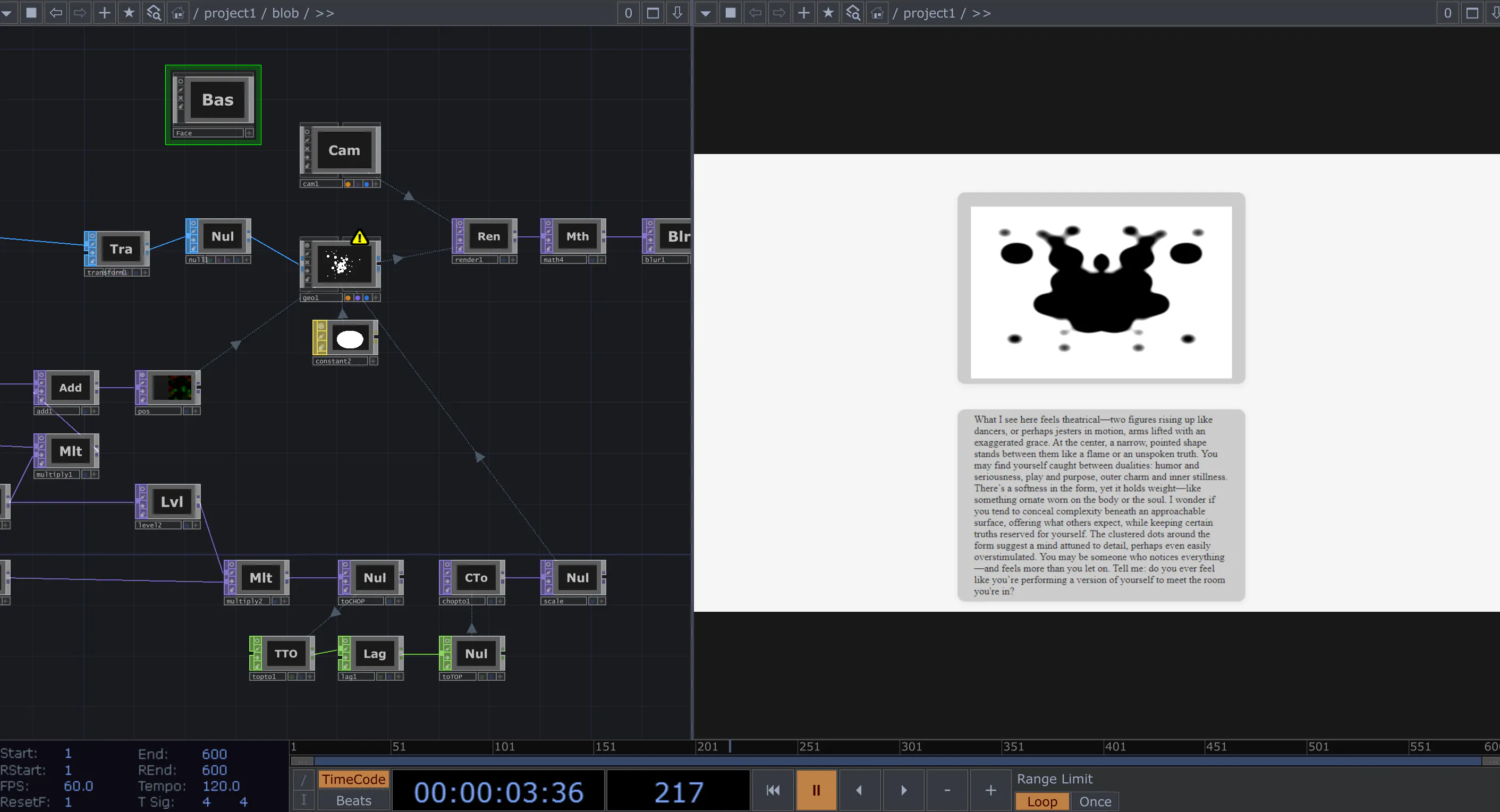
An inkblot, inspired by Rorschach. This one has yet to grow into a full Rorschach test. Here is one reaching its full size:

According to Carlbring and Andersson (2025), popular media is frequently incorporated into the beliefs or delusions of individual consumers. This is to be expected, given that our personal frames of reference are informed by our cultural schemas. [10] Structuralist analysis, for example through Barthes’ Mythologies (1957), allows us to understand the construction of these cultural references, and by doing so, perhaps also allows us to appreciate their effects on the individual.
Structuralism was not cultivated to investigate the interior of the individual. Attempting to implement it for this purpose, it becomes rather like an analogue to psychoanalysis. As a practice in which dreams and free associations are interpreted in an attempt to deconstruct the individual’s schemas, the theory is quite like a forefather to the (albeit also geriatric) structuralist analysis. [11]
It is through this association that I explain the significance of the Rorschach inkblot test, a psychological assessment in which ambiguous inkblot images are shown to a person, for the Machinic Analyst. The inkblot is rooted in psychoanalytic tradition but has also taken on a life of its own in contemporary media. Now, it shows up as a signifier in media such as films and videogames, usually to indicate a dark or troubled psychological constitution (Mindhunter, 2017), or rather as an ironic reference to pseudo-scientific practices (Fallout: New Vegas, 2010). Both references assume that for many, the inkblot is recognisable without diegetic context while representing the psychoanalytic tradition at large.
It is on the presumption of this cultural recognition that I built an AI which uses facial recognition software to analyse a human face, translate this data into a Rorschach inkblot, to then analyse this inkblot and return the analysis to the person whose face was just analysed. In the example of the inkblot above, the Analyst would say something like:
The AI that produces this text (ChatGPT version 5) is given a simple prompt before receiving the image: ‘act as though you were a psychoanalyst analysing your client with the help of this inkblot.’ This is enough for the machine to start spouting claims which are not altogether unconvincing. The language that it uses is persuasive in part because of the style it is written in. Put plainly, the use of ‘You’ and the vagueness of the claims together create the required conditions for the Barnum effect, [12] meaning that these statements are likely to resonate with the reader regardless of their accuracy. Of course, these effects are strengthened because this particular claim is specifically generated for and attributed to the person who has just been analysed.
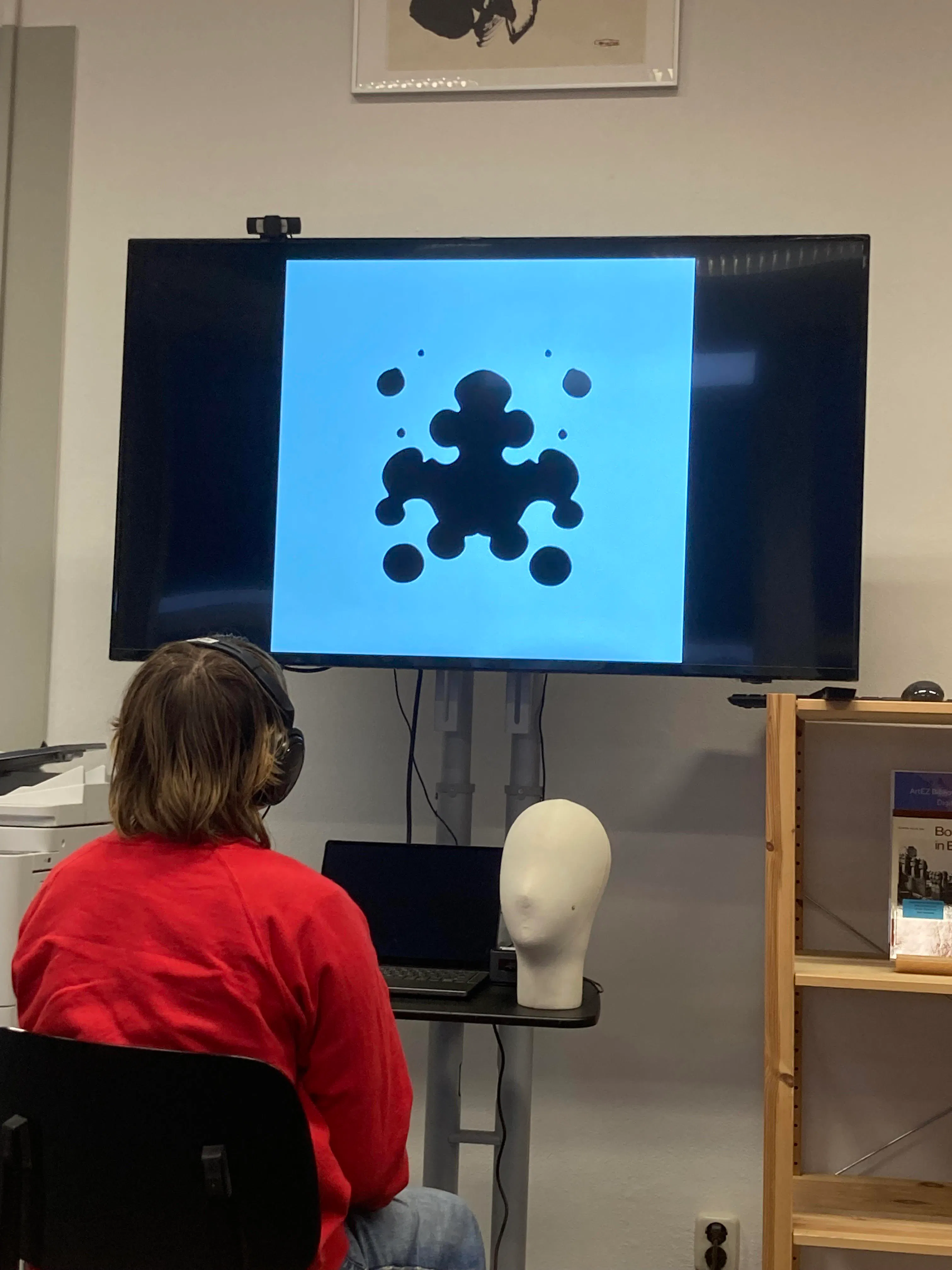
Exhibition in the ArtEZ library, Arnhem

‘I see a tall, austere figure in a high hat, arms stretched wide like a conjurer commanding a stage—or a sentinel barring passage. There is something theatrical yet guarded here, as if you present a composed persona while concealing a sharper, watchful core. The downward shapes suggest a hidden weight, an unspoken seriousness beneath the performance. You reach outward, but on your own terms; control protects you from exposure. This blot speaks of a mind that values poise and authority, yet wrestles with the fear that if you relax your stance, something unruly will spill out. You live between display and restraint, longing to be seen without surrendering command.’
Discussion
After organising a small exhibition for the project, I catalogued the feedback received by people who shared their experiences and dove back into the literature.
One particular observation which came up frequently was that the language used felt similar to that of astrological readings, a practice which, regardless of its theoretical standing, is undeniably important to our cultural landscape. On this, the literature suggests that the Barnum effect again plays an important role in the phrasing of astrological readings and analyses. [13]
Another noteable observation was that the machine could be likened to the chatbot called ELIZA (1966). This chatbot, which was believed by some to be capable of having therapeutic applications, [14] highlighted many of the current concerns and mechanisms, and led to the publishing of the book Computer Power and Human Reason (1976), which deals with early formation of regulative strategies of machine intelligence, in many ways a precursor to the current discourse.
And lastly, a third observation was that the engagement with the machinic analyst brought out a mystical quality that, upon reflection, is already present in regular AI models. This observation led me to find a chapter from the book Navigating the Mindfield (2008) in which the Rorschach inkblot and subsequent analysis is likened to cold reading techniques, which the author suggests in a somewhat derogatory fashion.
Of course, observations drawn from this artistic research need to be contextualised with the acknowledgement that the AI was specifically asked to impersonate a psychoanalyst. This means that the language that it used does not have to be reflective of the language that it typically employs when not prompted the same way. However, what remains clear is that AI is perfectly capable of utilising language in a compelling way, even when it behaves in ways that do not directly contribute to sycophantic goals. And, in understanding the rising popularity of AI chatbots for the purpose of mental healthcare provision, it seems that the question should not be limited to how the AI functions to make us believe in it. Perhaps we should be asking what part of us is so susceptible to linguistic mechanisms that make us feel seen.
Bibliography
- Moore, J., Grabb, D., Agnew, W., Klyman, K., Chancellor, S., Ong, D. C., & Haber, N. (2025). Expressing stigma and inappropriate responses prevents LLMs from safely replacing mental health providers. Proceedings of the 2025 ACM Conference on Fairness, Accountability, and Transparency (pp. 599-627). https://doi.org/10.48550/arXiv.2504.18412
- Hajek, A., Zwar, L., Gyasi, R.M., Yon, D.K., Pengpid, S., Peltzer, K. & König, H.H. (2025). Association of using AI tools for personal conversation with social disconnectedness outcomes. Journal of Public Health. https://doi.org/10.1007/s10389-025-02554-6
- Wei, M. (2025). The Emerging Problem of “AI Psychosis”. Psychology Today. https://www.psychologytoday.com/us/blog/urban-survival/202507/the-emerging-problem-of-ai-psychosis
- Morrin, H., Nicholls, L., Levin, M., Yiend, J., Iyengar, U., DelGuidice, F., Bhattacharya, S., Tognin, S., MacCabe, J., Twumasi, R., Alderson-Day, B. & Pollak, A.T. (2025). Delusions by design? How everyday AIs might be fuelling psychosis (and what can be done about it). PsyArXiv. https://doi.org/10.31234/osf.io/cmy7n_v5
- Carlbring, P. & Andersson, G. (2025). Commentary: AI psychosis is not a new threat: Lessons from media-induced delusions, Internet Interventions, 42, https://doi.org/10.1016/j.invent.2025.100882
- Cheng, M., Lee, C., Khadpe, P., Yu, Sunny., Han, D. & Jurafsky, D. (2025). Sycophantic AI Decreases Prosocial Intentions and Promotes Dependence, Cornell University, arXiv. https://doi.org/10.48550/arXiv.2510.01395
- Liu, A.R., Pataranutaporn, P. & Maes, P. (2025). Chatbot Companionship: A Mixed-Methods Study of Companion Chatbot Usage Patterns and Their Relationship to Loneliness in Active Users. Cornell University. https://doi.org/10.48550/arXiv.2410.21596
- Xia, H., Chen, J., Qiu, Y., Liu, P., & Liu, Z. (2025). The Impact of Human–Chatbot Interaction on Human–Human Interaction: A Substitution or Complementary Effect. International Journal of Human–Computer Interaction, 41(2), 848–860. https://doi.org/10.1080/10447318.2024.2305985
- Østergaard, S.D. (2023). Will Generative Artificial Intelligence Chatbots Generate Delusions in Individuals Prone to Psychosis?. Schizophrenia Bulletin 49(6), 1418–1419 https://doi.org/10.1093/schbul/sbad128
- Wood, M.L., Stoltz, D.S., Ness, J.V. & Taylor, M.A. (2018). Schemas and Frames. Sociological Theory. https://doi.org/10.17605/OSF.IO/B3U48
- Dickson, D. H., & Kelly, I. W. (1985). The ‘Barnum Effect’ in Personality Assessment: A Review of the Literature. Psychological Reports, 57(2), 367-382. https://doi.org/10.2466/pr0.1985.57.2.367
- Huizi, C. & Yiwei, X. (2022) Understanding the Impact of Barnum Effect in Astrology: An Eye-tracking Study. The Frontiers of Society, Science and Technology, 4(12), https://doi.org/10.25236/FSST.2022.041210
Footnotes
- J. Moore et al., ‘Expressing Stigma and Inappropriate Responses Prevents LLMs from Safely Replacing Mental Health Providers,’ in Proceedings of the 2025 ACM Conference on Fairness, Accountability, and Transparency (2025), pp. 599–627.
- A. Hajek et al., ‘Association of Using AI Tools for Personal Conversation with Social Disconnectedness Outcomes,’ Journal of Public Health (2025).
- H. Morrin et al., ‘Delusions by Design? How Everyday AIs Might Be Fuelling Psychosis (and What Can Be Done about It),’ PsyArXiv (2025).
- M. Wei, ‘The Emerging Problem of “AI Psychosis,”’ Psychology Today, November 27, 2025.
- M. Cheng et al., ‘Sycophantic AI Decreases Prosocial Intentions and Promotes Dependence,’ arXiv (2025).
- Cheng et al. 2025.
- Ibid
- A. R. Liu, P. Pataranutaporn, and P. Maes, ‘Chatbot Companionship: A Mixed-Methods Study of Companion Chatbot Usage Patterns and Their Relationship to Loneliness in Active Users’ (2024).
- H. Xia et al., ‘The Impact of Human–Chatbot Interaction on Human–Human Interaction: A Substitution or Complementary Effect,’ International Journal of Human–Computer Interaction 41.2 (2025), pp. 848–860.
- Van Ness et al. 2018.
- For further reading, I recommend Gilles Deleuze’s essay ‘What Is Structuralism?’ (1967) in which structuralism is, among other things, connected to its psychoanalytic forefathers.
- D. H. Dickson and I. W. Kelly, ‘The “Barnum Effect” in Personality Assessment: A Review of the Literature,’ Psychological Reports 57.2 (1985): pp. 367–382.
- C. Huizi and X. Yiwei, ‘Understanding the Impact of the Barnum Effect in Astrology: An Eye-Tracking Study,’ The Frontiers of Society, Science and Technology 4.12 (2022).
- K.M Colby, J.B. Watt and J.P. Gilbert, ‘A Computer Method of Psychotherapy: Preliminary Communication,’ Journal of Nervous and Mental Disease 142.2 (1966): pp. 148–152.